
Author: Sebastian Brock
Affiliation: Emeritus Reader in Syriac Studies, Oriental Institute, University of Oxford, Pusey Lane, Oxford OX1 2LE, United Kingdom
Email: sebastian.brock@ames.ox.ac.uk
Language: English
Issue: 1/2026 (26)
Pages: 32–43 (21 pages)
Keywords: Isaac of Nineveh; Syriac Christianity; manuscript transmission; textual criticism; Greek translation; monastic literature; ecumenical reception
Abstract
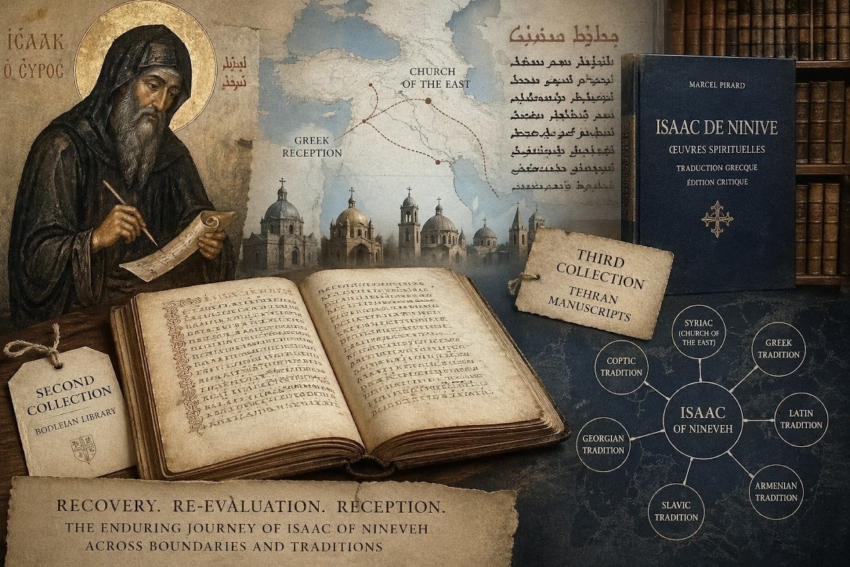
This article examines recent discoveries and re-discoveries of the writings of Isaac of Nineveh (St Isaac the Syrian), focusing in particular on the recovery of previously unknown collections and the critical re-evaluation of the Greek textual tradition. Drawing on manuscript evidence and modern editions, it traces the transmission of Isaac’s works across linguistic and ecclesiastical boundaries, from their origins within the Church of the East to their reception in Greek, and subsequently in a wide range of other traditions. Special attention is given to the rediscovery of the so-called “Second Collection” in the Bodleian Library and to the emergence of a “Third Collection” from manuscript material in Tehran, as well as to questions of authorship and authenticity in relation to newly attributed texts. The article further highlights the significance of Marcel Pirard’s critical edition of the Greek translation, which provides, for the first time, a reliable textual basis for the study of Isaac’s corpus. It is argued that these developments do not merely expand the known body of Isaac’s writings, but fundamentally reshape our understanding of their transmission, textual formation, and reception. At the same time, they shed new light on the broader cultural and ecclesiastical dynamics through which Isaac’s works have acquired a remarkable ecumenical significance, culminating in their renewed recognition across multiple Christian traditions.
Sebastian P. Brock
Sebastian P. Brock (b. 1938, London) is one of the foremost scholars in Syriac studies and a leading authority on the language and literature of Syriac Christianity. He studied at Trinity College, Cambridge, and completed his doctorate at the University of Oxford. After teaching at the Universities of Birmingham and Cambridge, he joined Oxford, where he served as Reader in Syriac Studies at the Oriental Institute until 2003; he is now Emeritus Reader and Emeritus Fellow of Wolfson College, Oxford. His research focuses on Classical Syriac literature and the cultural and intellectual history of Syriac Christianity, and his work has been foundational for modern scholarship in the field.
 PDF
PDFIntroduction
St Isaac the Syrian has long been a much-loved monastic author in the Orthodox world, thanks to the collection of eighty-six discourses and four Epistles that have been available in Greek since the ninth century, and in printed form since 1770.[1] In recent years, however, a number of further discourses have come to light, and research has clarified several intriguing features concerning the transmission of the texts that came to be translated into Greek.[2] The present article examines these recent discoveries and re-discoveries of Isaac’s writings, and considers how they significantly reshape our understanding of the extent, transmission, and wider reception of his work.
Since our journey will end at Moni Iviron on Mount Athos, it is appropriate to begin with a modern witness from the Holy Mountain, Archimandrite Vasileios. In his book Hymn of Entry: Liturgy and Life in the Orthodox Church, he quotes (pp. 131–132) the words of a young monk who has been given St Isaac’s discourses to read:
“I am reading St Isaac the Syrian. I find something true, heroic and spiritual in him, something which transcends space and time. I feel that here, for the first time, is a voice which resonates in the deepest parts of my being, hitherto closed and unknown to me. Although he is so far removed from me in time and space, he has come right into the house of my soul. In a moment of quiet he has spoken to me, sat down beside me. Although I have read so many other things, although I have met so many other people, and though today there are others living around me, no one else has been so discerning. To no one else have I opened the door of my soul in this way. Or, to put it better, no one else has shown me in such a brotherly, friendly way that, within myself, within human nature, there is such a door – a door which opens onto a space that is open and unlimited. And no one else has told me this unexpected and ineffable truth: that the whole of this inner world belongs to man.”
Who was St Isaac?
Known generally as St Isaac the Syrian, or St Isaac of Nineveh, Isaac was in fact neither a Syrian, nor was he from Nineveh (modern Mosul, in Iraq). The designation ‘Syrian’ refers rather to the language in which he wrote, Syriac (a dialect of Aramaic), while Nineveh was the episcopal see to which he was briefly appointed before retiring to live the life of a hermit in what is today western Iran.
Isaac in fact originated from Beth Qatraye[3], the region of present-day Qatar on the western side of the Persian Gulf. In the seventh century, to the latter half of which Isaac’s adult life belongs, Beth Qatraye was an important intellectual centre for the Church of the East, and at least two other significant Syriac authors of that century likewise came from this region. At some time in the late 670s, the Catholicos of the Church of the East, Gewargis (George), visited Beth Qatraye and, on his return, brought Isaac back with him, appointing him bishop of Nineveh.
After only a few months, however, Isaac resigned, ‘for reasons only God knows’ (as one of the two short biographical notices about him puts it), and withdrew to a monastery founded by Rabban Shabur a generation or so earlier, situated somewhere in the region of Shustar (Iran); the exact site is no longer known.[4] The rest of his life was spent as a hermit attached to the Monastery of Rabban Shabur, attending the Saturday night vigil and Sunday liturgy at the monastery before retiring to his cell for the remainder of the week. It may well be that many of his discourses were taken down from dictation in his old age, since he is said to have gone blind towards the end of his life.
This biographical background is essential for understanding both the linguistic context of Isaac’s writings and the channels through which they later circulated beyond their original ecclesiastical setting.
In recent years, the memory of St Isaac’s connection with the Qatar region has been revived. The recently built Greek Orthodox church outside the modern city of Doha has appropriately been dedicated to him, and at the end of February 2014 a conference was held at the University of Qatar on seventh-century Syriac authors from Beth Qatraye, one of whom was St Isaac.
His writings: the first collection
It appears that several volumes, or collections, of St Isaac’s writings were known in the Middle Ages, though the number varies in different sources, with the highest figure being seven. Only the first of these volumes (or ‘parts’) has long been widely known. Before turning to the recent discoveries, however, it is helpful to outline how this first volume has come down to us.
The original Syriac text of this collection contains eighty-two discourses and is transmitted, wholly or in part, in manuscripts belonging to all three Syriac ecclesiastical traditions: the Church of the East, the Syrian Orthodox Church, and the Chalcedonian Orthodox (‘Melkite’) tradition.[5] In one of the Chalcedonian manuscripts, preserved in St Catherine’s Monastery on Mount Sinai, a note indicates that it was written in the Monastery of St Sabas near Jerusalem. Although the manuscript (Sinai syr. 24, with fragments now in Milan and Paris) is undated, it very probably belongs to the ninth century – precisely the period when the Greek translation of Isaac’s discourses was produced in the same monastery by the monks Abraamios and Patrikios.[6] Remarkably, a fragmentary Greek manuscript of this translation, also dating from the ninth century and probably copied in Palestine, has likewise survived.
It is noteworthy that the Greek translation retains the identification of Isaac as ‘bishop of Nineveh’, despite the fact that this see belonged to the Church of the East.[7] Other sources likewise suggest that, at least in monastic circles, some contact continued between the Church of the East and the Chalcedonian Orthodox Church in Palestine and Sinai. The Greek translation differs slightly in content from the Syriac original: it contains eighty-six discourses (some longer Syriac texts having been subdivided) and four Epistles. It also incorporates four texts by other Syriac authors – three by the slightly later East Syriac monastic writer John of Dalyatha (John the Elder), and one by the earlier Syrian Orthodox author Philoxenos of Mabbug (d. 523).
These features provide important evidence for the ways in which monastic texts circulated across ecclesiastical boundaries.[8] The potential difficulty posed by citations from authors accepted in one Church but not in another was often resolved by the simple expedient of altering names. Thus quotations from Theodore of Mopsuestia and Evagrius were reassigned in the Greek translation to figures such as John Chrysostom, Gregory of Nazianzus, and Nilus – a practice also attested in the transmission of other patristic texts associated with authors who later came under condemnation.
It was through the Greek translation produced at the Monastery of St Sabas that Isaac’s writings reached a much wider audience. In the West, they were subsequently translated into Latin and Slavonic (and thence into Russian), while in the East they were rendered into Georgian and Arabic (and from Arabic into Ethiopic).
The publication history of this first volume followed a somewhat unusual trajectory. Long before the Syriac original became known, the Greek text was first published in Leipzig in 1770 by the editor Hieromonk Nikephoros Theotokis. Theotokis relied on relatively late manuscripts and arranged the material in what he considered a more logical order. His rare edition was later reprinted, with minimal changes, by Hieromonk Ioakim Spetsieris in 1895, and reprints of this version remained the only available editions until relatively recently.
It was not until 1909 that the Syriac original was published, again in Leipzig, edited by the prolific scholar of Syriac texts, the Chaldean priest Paul Bedjan. This Syriac text was subsequently translated into English by the Dutch scholar A. J. Wensinck.[9] Since Bedjan preserved the chapter numbering of the Syriac manuscript he used, the numbering in Wensinck’s translation differs from that of the Greek tradition, on which several later translations are based, notably the French translation by Jacques Touraille (1981)[10]. As a result, it is essential, when citing modern translations, to indicate whether they follow the Greek or Syriac numbering.
Wensinck’s translation, published in the Verhandelingen of the Royal Dutch Academy in Amsterdam, reached only a limited readership (though more accessible reprints have since appeared). Consequently, many English-speaking readers first encountered Isaac’s writings in 1954, through the extracts included in the Russian Philokalia, published in English as Early Fathers from the Philokalia, translated by E. Kadloubovsky and G. E. H. Palmer.
A major development came in 1984 with a new English translation produced by the Holy Transfiguration Monastery (Brookline, Massachusetts).[11] Based primarily on the Greek text, but also making use of the Syriac original, this edition included several discourses not preserved in Greek, translated directly from Syriac. It was later reissued in 2011 in a slightly shortened form. Five years after the appearance of this edition, Mary Hansbury[12] published a new English translation of the first six discourses, made directly from the Syriac, with St Vladimir’s Seminary Press.
This brings us slightly beyond 1983, the year in which a second volume of Isaac’s discourses was rediscovered. Although the history of the first volume reaches a significant culmination in 2012 with the publication of a critical edition of the Greek translation, it will be more convenient to proceed chronologically and return to this new edition at a later stage.
A second collection recovered: Urmia, Tehran – and Oxford
When Paul Bedjan published the Syriac text of the first volume in 1909[13], he included several short excerpts from an old manuscript in Urmia (north-west Iran), containing what he described as a ‘second part’ of Isaac’s works, which he considered to include some ‘very beautiful’ texts. This manuscript has since disappeared and was very probably lost during the massacres that took place in Urmia at the end of the First World War.
Fortunately, another manuscript of this second volume existed in the Urmia region in the late nineteenth century. It had been sold by the Revd Yaroo Neesan to the Bodleian Library, Oxford, in 1898. Neesan, a native of the Urmia region and a cleric in American Episcopalian orders, had also had the manuscript copied in 1895 before bringing it to Europe. This copy later came into the possession of the Chaldean Bishop of Tehran, Mar Yohannan Shem‘on Issaye.
The older manuscript arrived in Oxford after the publication of the Bodleian Library’s catalogue of Syriac manuscripts and was therefore recorded only in a handwritten card index of more recent acquisitions. As a result, it remained unnoticed until 1983, when, while consulting the index, I ordered it out of curiosity. On examining the manuscript, it was immediately clear that it was an early copy (probably from the tenth or eleventh century) and that it was described as ‘the second part’ of Isaac’s writings. Although I was aware that one part of Isaac’s works had been lost, I did not at first recall which; it was only after checking the details later that I realised the significance of the find. The discovery – or rather, rediscovery – of the lost second volume was subsequently announced at the Oxford Patristic Conference later that year.
This rediscovery proved to be of considerable importance, as it significantly expanded the known corpus of Isaac’s writings and provided new insight into the development of his thought.
The second volume contains forty-one chapters, of which chapter 3, occupying nearly half the manuscript, consists of four sets of numbered short ‘Spiritual Headings’ (Kephalaia Gnostica). Two chapters are duplicates of discourses already known from the first volume (I, ch. 54–55 = II, ch. 16–17). Among the final chapters is one entitled ‘On the mystery of Gehenna (Hell)’, in which Isaac develops reflections on this ‘difficult subject’, already hinted at in the first volume.
Discovering such an important text is one thing; finding the time to edit and translate it is another. Fortunately, an Italian colleague, Paolo Bettiolo, who was working on collections of Kephalaia Gnostica, undertook to edit the large section comprising chapter 3 (together with the first two chapters). As early as 1985 he produced an initial Italian translation, followed by a revised edition in 1990; his edition of the Syriac text, however, has yet to appear. The remaining chapters (4–41) were eventually edited and translated by myself and published in 1995.[14] The first three chapters were later made available in English in Isaac of Nineveh, Headings on Spiritual Knowledge (2022).
These newly recovered texts attracted considerable interest, especially in Orthodox circles. In Oxford in the late 1990s, a Russian student, after completing his doctoral thesis on St Symeon the New Theologian, expressed interest in translating the new material into Russian. The student in question, Hilarion Alfeyev (now Metropolitan Hilarion)[15], found it easier to work from a more literal rendering of the Syriac than from my more literary translation. We therefore collaborated, with me translating the Syriac orally as literally as possible, while he produced a Russian draft which he later refined; this was published in Moscow in 1998. Around the same time, he produced an important introduction to Isaac’s spiritual teaching, published in both Russian and English (The Spiritual World of Isaac the Syrian, 2000). More recently, in November 2013, Metropolitan Hilarion organised a conference in Moscow devoted specifically to Isaac’s writings.
In Romania, where a translation of the entire first volume had already appeared in the Romanian Philokalia (translated by the late Dumitru Stăniloae), the newly discovered second volume was translated by Ioan Ică (2003), based on the available English and Italian versions (for the Kephalaia Gnostica). The same year saw two further translations made directly from the Syriac: one into French, by the late André Louf (in the series Spiritualité orientale), covering the entire second volume, and another into Catalan, limited to the Kephalaia Gnostica, by Manel Nin, Rector of the Greek College in Rome. Two years later, in 2005, Nestor Kavvadas published a complete translation into Modern Greek, again based directly on the Syriac original.
Although the second volume was never translated into Greek in antiquity, it is important to note that individual chapters have nevertheless been identified in Chalcedonian Orthodox manuscripts, both in Syriac and in Arabic translation.
A third collection emerges: Tehran
At some point in the late 1980s or early 1990s, the late Fr Michel van Esbroeck, a specialist in Oriental Christian literatures, was able, during a visit to Tehran, to photograph several manuscripts in the library of the Chaldean bishop, Mar Issayi, whom I have already mentioned. Among the manuscripts he photographed was the copy of the second volume of Isaac’s discourses, made in 1895. Another manuscript was described as ‘the third part’ of Isaac’s writings; this contained a further seventeen discourses, three of which, however, proved to be duplicates of texts already known from the other two volumes (I, 22, 40 = III, 14–15; II, 25 = III, 17).
Yet another chapter, surprisingly in verse, was also found to be previously known, though transmitted separately under the name of Ephrem. It is in fact unlikely that either Ephrem or Isaac was the true author of this piece. The remaining chapters, however, appear to be genuinely by Isaac, and some individual texts are likewise attested in both Syrian Orthodox and Chalcedonian Orthodox manuscript traditions.
Although more limited in scope than the second collection, this third volume nevertheless provides further important evidence for the transmission and reception of Isaac’s writings across different linguistic and ecclesiastical contexts.
This third volume has now been edited and translated into Italian (2011) by Fr Sabino Chialà of the Community of Bose (Italy)[16], a scholar who had earlier produced a major study of Isaac’s writings, Dall’ascesi eremitica alla misericordia infinita (2002). A French translation, again by Fr André Louf, appeared in 2009, shortly before his death. An English translation, by Mary Hansbury, is now also available: Isaac the Syrian’s Spiritual Works (Piscataway, NJ: Gorgias Press, 2016).
Two chapters from a fifth volume?
In 2013, Fr Sabino Chialà published two additional chapters said to derive from an otherwise unknown fifth volume of Isaac’s writings.[17] These texts, however, differ markedly in character from those found in the other three volumes, and it therefore seems likely that they are not in fact the work of Isaac of Nineveh.
This case serves as a useful reminder that the expansion of Isaac’s corpus must be approached with caution, and that questions of authorship remain an important issue in the transmission of his writings.
The critical edition of the Greek translation: return to Mount Athos
It has long been recognised that the edition of the Greek translation prepared by Theotokis, together with its subsequent reprints, is highly unsatisfactory, and that a new edition based on early manuscripts has long been needed. Already in the 1970s, Archimandrite Vasileios of Stavronikita Monastery began collecting materials for such an edition; these were later passed on, in 2000, to Marcel Pirard, an exceptionally skilled independent scholar with expertise in both Syriac and Greek.
Only twelve years later – a remarkably short time, given the scale of the task and the labour involved in collating a large number of manuscripts – Pirard produced a monumental critical edition of the Greek text, published by the Moni Iviron. The volume extends to 887 pages, of which more than 200 are devoted to an extensive introduction analysing the Greek manuscript tradition. The edition is based on thirty-one manuscripts, all earlier than the sixteenth century, including the ninth-century fragmentary manuscript mentioned above, as well as several early witnesses preserved in the library of St Catherine’s Monastery on Mount Sinai; the remaining manuscripts are largely drawn from monastic libraries on Mount Athos.
Pirard’s critical edition[18], with its detailed apparatus of variant readings and its notes highlighting significant divergences from the Syriac tradition, is primarily intended for specialist use. Nevertheless, it represents a decisive advance in the study of Isaac’s writings and finally provides a reliable textual basis for further research.
In this respect, the new edition marks a culmination of the developments traced in this article, bringing together the manuscript tradition, modern discoveries, and critical scholarship into a coherent and authoritative form.
It is therefore to be hoped that, in due course, a more accessible version of the Greek text will be made available for a wider readership, replacing the unsatisfactory reprints that ultimately derive from the Leipzig edition of 1770.
By way of conclusion
With the recovery, over the last thirty years, of previously unknown discourses by St Isaac, there has been a considerable revival of interest in this monk of the Church of the East, whose works have, paradoxically, long been better known in other Christian traditions than in his own.
The developments traced in this article demonstrate that recent discoveries and critical editions have not merely expanded the corpus of Isaac’s writings, but have fundamentally reshaped our understanding of their transmission, textual formation, and reception across different ecclesiastical and linguistic contexts.
It is equally striking that this hermit, who never returned to the world during his lifetime to share his teaching beyond the monastic setting, should now, in very different circumstances, have made such a return, speaking across the centuries to both monastic and lay readers.
Reflecting on this complex history of transmission, it becomes clear that Isaac’s discourses have crossed not only numerous linguistic boundaries, especially in recent decades with translations into many languages, but also significant ecclesiastical ones. As noted above, already in the ninth century a large collection of his writings had moved from the Church of the East into the Greek Orthodox tradition, by way of the Syrian Orthodox. In modern times, this ecumenical dimension has become even more apparent.
It is notable that Isaac was never formally recognised as a saint in any liturgical calendar in earlier periods. In recent decades, however, he has increasingly been accorded this title in scholarly and ecclesiastical contexts, and the Greek Orthodox church in Doha (Qatar) has been dedicated to him, appropriately reflecting his origins in the Qatar region. In his own Church, a synod of the Assyrian Church of the East, held in Erbil in April 2024, decreed that ‘a commemoration of Mar Isaac of Nineveh should be held on the Fifth Sunday of the Great Fast’. Later that same year, during a visit of the Catholicos Mar Awa III to Rome, Pope Francis stated that ‘the great Isaac of Nineveh, one of the most venerated Fathers of the Syro-Oriental tradition, acknowledged as a teacher and a saint by all traditions, will be added to the Roman Martyrology’.
In this sense, the trajectory of Isaac’s writings – from their origins in the Church of the East, through their transmission across languages and traditions, to their renewed recognition in the present – illustrates not only the historical movement of texts, but also their enduring capacity to shape spiritual and intellectual life across confessional boundaries. It is therefore possible to extend the title of this article to read: St Isaac the Syrian: from Tehran to Moni Iviron, Mount Athos – and on to Rome.
[1] PIRARD, M. Abba Isaak tou Syrou Logoi Asketikoi. Mount Athos, 2012; WENSINCK, A. J. Mystic Treatises by Isaac of Nineveh. Amsterdam, 1923.
[2] BROCK, S. P. Isaac of Nineveh… Second Part. Leuven, 1995; CHIALÀ, S. Dall’ascesi eremitica…. Firenze, 2002.
[3] BROCK, S. P. ‘St Isaac of Nineveh and Syriac Spirituality’. 1975.
[4] ALFEYEV, H. The Spiritual World of Isaac the Syrian. 2000.
[5] WENSINCK, A. J. Mystic Treatises… 1923; BROCK, S. P. 1995.
[6] PIRARD, M. 2012.
[7] BROCK, S. P. 2015.
[8] BROCK, S. P. ‘The Ecumenical Journeys…’ 2024.
[9] WENSINCK, A. J. 1923.
[10] TOURAILLE, J. Isaac le Syrien. Paris, 1981.
[11] MILLER, D. The Ascetical Homilies… Boston, 1984 (rev. 2011).
[12] HANSBURY, M. Spiritual Works. 2016.
[13] WENSINCK, A. J. 1923.
[14] BROCK, S. P. 1995.
[15] ALFEYEV, H. The Spiritual World… 2000.
[16] CHIALÀ, S. Terza collezione. Leuven, 2011.
[17] CHIALÀ, S. 2002.
[18] PIRARD, M. 2012.
References
ALFEYEV, Hilarion (ed.). St Isaac the Syrian and His Spiritual Legacy. Yonkers, NY, 2015.
ALFEYEV, Hilarion. L’univers spirituel d’Isaac le Syrien. Spiritualité Orientale 76. 2001.
ALFEYEV, Hilarion. The Spiritual World of Isaac the Syrian. Kalamazoo, 2000.
BEGGIANI, Seely. Introduction to Eastern Christian Spirituality: The Syriac Tradition. London, 1991.
BITTON-ASHKELONY, Brouria. ‘From Evagrius Ponticus’ Pure Prayer to Isaac of Nineveh’s Non-Prayer’. In: BITTON-ASHKELONY, Brouria. The Ladder of Prayer and the Ship of Stirrings. Leuven, 2019, ch. 3. https://doi.org/10.2307/j.ctv1q26njh
BROCK, Sebastian P. ‘Isaac the Syrian’. In: CONTICELLO, G. (ed.). La théologie byzantine I. Turnhout, 2015, pp. 327–372.
BROCK, Sebastian P. ‘St Isaac of Nineveh and Syriac Spirituality’. Sobornost / Eastern Churches Review, 1975, 7(2), pp. 79–89.
BROCK, Sebastian P. ‘The Ecumenical Journeys of the Writings of Isaac of Nineveh (Isaac the Syrian)’. Sobornost / Eastern Churches Review, 2024, 46(2), pp. 56–75.
BROCK, Sebastian P. ‘Two Unpublished Texts by St Isaac the Syrian’. Sobornost / Eastern Churches Review, 1997, 19(1), pp. 7–33.
BROCK, Sebastian P. Isaac of Nineveh (Isaac the Syrian), the “Second Part”, chapters IV–XLI. Leuven: Corpus Scriptorum Christianorum Orientalium, 1995.
BROCK, Sebastian P. Isaac of Nineveh, Headings on Spiritual Knowledge (The “Second Part”, chapters 1–3). Yonkers: St Vladimir’s Seminary Press, 2022.
D’AYALA, L.; CHIALÀ, Sabino; CREMASCHI, L. (eds.). Isacco di Ninive e il suo insegnamento spirituale. Magnano, 2023.
DUCA, Valentina. ‘Exploring Finitude: Weakness and Integrity in Isaac of Nineveh’. Orientalia Lovaniensia Analecta, 2022, no. 309. https://doi.org/10.2307/jj.6988023
HAGMAN, Patrik. The Asceticism of Isaac of Nineveh. Oxford, 2010. https://doi.org/10.1093/acprof:oso/9780199593194.001.0001
CHIALÀ, Sabino. ‘Prayer and the Body according to Isaac of Nineveh’. In: BITTON-ASHKELONY, Brouria and KRUEGER, Derek (eds.). Prayer and Worship in Eastern Christianities, 5th–11th Centuries. London, 2016, pp. 34–43.
CHIALÀ, Sabino. Dall’ascesi eremitica alla misericordia infinita. Ricerche su Isacco di Ninive e la sua fortuna. Firenze, 2002.
CHIALÀ, Sabino. Discorsi ascetici. Prima collezione. Magnano: Edizioni Qiqajon, 2022.
KAVVADAS, Nestor. Isaak von Nineve und seine Kephalaia Gnostica: Die Pneumatologie und ihr Kontext. Leiden, 2015. https://doi.org/10.1163/9789004284838_002
KHALIFÉ-HACHEM, Elie. ‘Isaac de Ninive’. In: Dictionnaire de Spiritualité, 1971, vol. 7, pp. 2041–2054.
MAYES, Andrew. Diving for Pearls: Exploring the Depths of Prayer with Isaac the Syrian. Collegeville: Liturgical Press, 2021.
MILLER, Dana. The Ascetical Homilies of St Isaac the Syrian. Boston: Holy Transfiguration Monastery, 1984; revised edition 2011.
PAUNOIU, Georgian. Asceza și îndumnezeirea omului in opera Sfântului Isaac Sirul. Bucharest, 2019.
PIRARD, Marcel. Abba Isaak tou Syrou Logoi Asketikoi. Kritiki ekdosi. Mount Athos: Moni Iviron, 2012.
SCULLY, Jason. Isaac of Nineveh’s Ascetical Eschatology. Oxford, 2017. https://doi.org/10.1093/oso/9780198803584.001.0001
TOURAILLE, Jacques. Isaac le Syrien. Œuvres spirituelles. Paris, 1981.
VESA, Valentin. Knowledge and Experience in the Writings of St Isaac of Nineveh. Piscataway, NJ: Gorgias Press, 2018. https://doi.org/10.31826/9781463239947
VETTICKAL, Annie Noel. The Luminous Love: A Study on the Concept of Love Found in the Discourse of Isaac the Syrian. Kottayam: OIRSI, 2022.
WENSINCK, Arent Jan. Mystic Treatises by Isaac of Nineveh. Amsterdam, 1923; reprint Wiesbaden, 1969.